
Agricultural production in 2025 is projected to experience breakthrough growth, with impressive results in agriculture, forestry, and fisheries.
In 2025, agriculture, forestry, and fisheries are expected to experience impressive growth: food production will reach 47.9 million tons, with rice production increasing despite a decrease in planted area. Forestry will see a breakthrough with timber harvesting increasing by nearly 7%, and fisheries will reach nearly 10 million tons thanks to aquaculture. These results will ensure a stable domestic food supply and support exports...
Chu Khoi
1/9/20266 min read
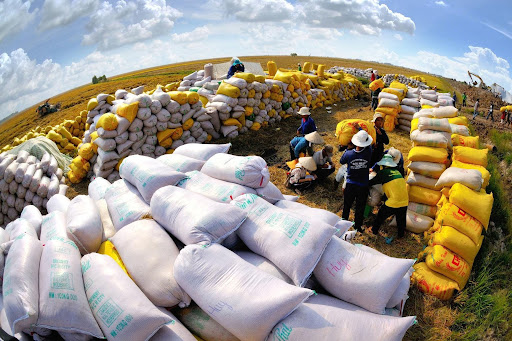
According to the General Statistics Office (Ministry of Finance), in 2025, the total harvested grain production nationwide will reach 47.9 million tons, an increase of 96.4 thousand tons compared to 2024. Of this: corn production will reach 4.4 million tons, an increase of 7.8 thousand tons; and rice production will reach 43.5 million tons, an increase of 88.6 thousand tons compared to the previous year.
RICE CULTIVATION AREA DECREASES, BUT HARVEST YIELD STILL INCREASES
The total area for rice cultivation in all seasons of 2025 is estimated at 7.13 million hectares, a decrease of 1,100 hectares compared to 2024, mainly due to the conversion of some rice land to crops with higher economic efficiency and non-agricultural land.
However, thanks to the application of new varieties and improved farming techniques, rice yield reached 61.1 quintals/hectare, an increase of 0.1 quintals/hectare; production reached 43.5 million tons, an increase of 88.6 thousand tons.
Specifically, the 2025 winter-spring rice crop covered nearly 3.0 million hectares, an increase of 15.7 thousand hectares. Yields reached 68.6 quintals/hectare, slightly reduced due to unfavorable weather and localized pest outbreaks, but production still reached 20.4 million tons, an increase of 32.1 thousand tons.
The summer-autumn rice crop was heavily affected by storms and floods, especially in the North Central region, the South Central Coast, and the Central Highlands. The planted area decreased by 10.8 thousand hectares, and the yield decreased by 1 quintal/hectare, resulting in a production loss of 269.1 thousand tons. The autumn-winter rice crop in the Mekong Delta and Tay Ninh province saw 716.6 thousand hectares planted, with increased yields and a production of 4.21 million tons.
For the main rice crop, the whole country planted 1.5 million hectares, with a sharp increase in yield to 52.4 quintals/hectare, helping the production reach 8.07 million tons, an increase of more than 314,000 tons. The North showed a clear recovery after being severely affected by typhoons in 2024, especially the Red River Delta region.
PERENNIAL CROPS ARE A HIGHLIGHT OF THE AGRICULTURAL INDUSTRY
In 2025, the planted area and production of some annual crops will continue to be adjusted towards reducing the number of low-economic-value crops and expanding the group of higher-value crops. Corn planted area reached 865.6 thousand hectares, a decrease of 5.9 thousand hectares compared to the previous year, but production is still estimated at 4.4 million tons, an increase of 7.8 thousand tons.
The area planted with peanuts reached 144.3 thousand hectares, a decrease of 4.2 thousand hectares, with an estimated yield of 388.1 thousand tons, a decrease of 9.1 thousand tons. The area planted with soybeans reached 26.3 thousand hectares, a decrease of 2.2 thousand hectares, with an estimated yield of 43.3 thousand tons, a decrease of 2.8 thousand tons. The area planted with sweet potatoes reached 77.0 thousand hectares, a decrease of 4.0 thousand hectares, with an estimated yield of 929.0 thousand tons, a decrease of 43.9 thousand tons.
Meanwhile, vegetable production continues to increase. The area under vegetable cultivation in 2025 is estimated to reach 1,002.9 thousand hectares, an increase of 3.1 thousand hectares compared to the previous year; the harvest yield is expected to reach 19.6 million tons, an increase of 519.5 thousand tons.
Perennial crop production continues to thrive thanks to relatively favorable weather conditions, especially during the flowering and fruiting stages. The implementation of programs connecting product consumption, building value chains, assigning planting area codes, ensuring traceability, applying e-commerce, and expanding export markets have contributed to improved production efficiency and stable output.
The area of perennial industrial crops is estimated at 2,195.8 thousand hectares, an increase of 0.5% compared to 2024. Of this, coffee production reached 2,116.1 thousand tons, an increase of 5.0%; rubber reached 1,346.1 thousand tons, an increase of 1.4%; tea leaves reached 1,161.4 thousand tons, an increase of 0.6%; pepper reached 274.8 thousand tons, an increase of 4.8%; while cashew nuts reached 293.0 thousand tons, a decrease of 4.3%. Coconut production reached 2,373.8 thousand tons, an increase of 4.1%, mainly in the Mekong Delta region.
The area of fruit trees reached 1,311.3 thousand hectares, an increase of 0.4%. Production reached 3,192.8 thousand tons of bananas; 1,820.9 thousand tons of durian; 1,402.2 thousand tons of jackfruit; 1,203.7 thousand tons of dragon fruit; 1,188.0 thousand tons of mangoes; 666.3 thousand tons of longan; 408.8 thousand tons of lychee; and 1,886.8 thousand tons of oranges.
Timber production increased by nearly 7%.
Regarding the forestry sector, the General Statistics Office reported that in the fourth quarter of 2025, the area of newly planted forests reached 103.5 thousand hectares, a decrease of 0.7% compared to the same period last year; the number of scattered forest trees planted reached 15.7 million trees, a decrease of 5.9%; and the volume of harvested timber reached 7,752.3 thousand cubic meters, an increase of 4.2%.
Overall in 2025, the area of newly planted forests in concentrated areas will reach 323.3 thousand hectares, an increase of 6.4%; the number of scattered trees planted will reach 85.3 million trees, a decrease of 0.3%; and the volume of harvested timber will reach 25,616.0 thousand m3, an increase of 6.9% compared to 2024.
Several localities experienced significant increases in timber production, including: Quang Tri (up 14.1%); Quang Ngai (up 11.3%); Ca Mau (up 11.1%); Thai Nguyen (up 9.7%); and Thanh Hoa (up 9.4%).
The area of forest damaged in the fourth quarter of 2025 was 129.3 hectares, a decrease of 28.8% compared to the same period of the previous year. Of this, 117.7 hectares were cleared (a decrease of 34.7%), and 11.6 hectares were burned (7.4 times higher than in the fourth quarter of 2024). Overall in 2025, the total area of forest damaged was 1,127.6 hectares, a decrease of 30.7%, including 801.2 hectares of cleared (a decrease of 9.5%) and 326.4 hectares of burned (a decrease of 56.0%).
AQUACULTURE PRODUCTION INCREASED BY 3%
Regarding the fisheries sector , the General Statistics Office reported that in the fourth quarter of 2025, the estimated fisheries production reached 2,689.1 thousand tons, an increase of 2.7% compared to the same period last year. This included 1,852.4 thousand tons of fish (up 2.6%), 417.7 thousand tons of shrimp (up 4.9%), and 419.0 thousand tons of other aquatic products ( up 1.0%).
Overall, in 2025, the total aquatic product output is projected to reach 9,947.5 thousand tons, an increase of 3.0% compared to 2024. This includes: fish 6,962.4 thousand tons, an increase of 2.7%; shrimp 1,522.2 thousand tons, an increase of 5.5%; and other aquatic products 1,462.9 thousand tons, an increase of 1.9% compared to 2024.
Aquaculture production harvested in Q4 2025 is projected to reach 1,826.7 thousand tons, an increase of 4.9% compared to Q4 2024. Of this, fish production will reach 1,238.3 thousand tons, an increase of 4.8%; shrimp production will reach 382.6 thousand tons, an increase of 5.5%; and other aquatic products will reach 205.8 thousand tons, an increase of 4.1%. Overall for 2025, aquaculture production is expected to reach 6,116.8 thousand tons, an increase of 5.1%, including: fish production of 4,035.0 thousand tons, an increase of 4.9%; shrimp production of 1,381.7 thousand tons, an increase of 6.1%; and other aquatic products of 700.1 thousand tons, an increase of 4.4%.
In the Mekong Delta, pangasius farming continues to develop; pangasius production in the fourth quarter of 2025 is expected to reach 592.9 thousand tons, an increase of 5.2% compared to the fourth quarter of 2024. For the whole year of 2025, pangasius production is projected to reach 1,938.8 thousand tons, an increase of 5.0% compared to 2024.
Brackish water shrimp farming has shifted strongly towards the application of high technology, especially for whiteleg shrimp; whiteleg shrimp production in the fourth quarter reached 274.7 thousand tons, an increase of 6.3%, and the whole year reached 994.4 thousand tons, an increase of 6.9%. Black tiger shrimp production in the fourth quarter reached 84.1 thousand tons, an increase of 3.4%, and the whole year reached 296.7 thousand tons, an increase of 3.6%.
The output of exploited aquatic products in the fourth quarter of 2025 reached 862.4 thousand tons, a decrease of 1.6%, of which fish accounted for 614.1 thousand tons, a decrease of 1.5%; and shrimp accounted for 35.1 thousand tons, a decrease of 2.0%. For the whole year of 2025, the output of exploited aquatic products reached 3,830.7 thousand tons, a decrease of 0.2%, including fish 2,927.4 thousand tons, a decrease of 0.2%; shrimp 140.5 thousand tons, a decrease of 0.4%; and other aquatic products 762.8 thousand tons, a decrease of 0.3%. The output of marine exploitation in the fourth quarter reached 808.4 thousand tons, a decrease of 1.4%; and for the whole year reached 3,638.6 thousand tons, a decrease of 0.1%.
The reasons for the decrease in fishing output are due to numerous storms and tropical depressions affecting marine fishing activities, and the tightening of penalties for illegal fishing activities according to Decree No. 38/2024/ND-CP.
Sources: VnEconomy
© 2025. All rights reserved.
We are always ready to support your sourcing needs and discuss customized solutions.
Let’s connect and explore how Vietcommodities can become your trusted partner!