The agriculture and environment sector has been resilient for 80 years, thriving in the new era.
Over 80 years of construction and development, starting from a difficult and deprived beginning, the agriculture and environment sector has risen to become one of the world's leading centers for agricultural production and export. This momentum is driven by effective resource and environmental management thinking, the application of advanced science and technology, and the vitality of the new rural development program, steadily moving towards the goal of ecological agriculture, modern rural areas, and civilized farmers…
Chu Khoi
1/23/20264 min read
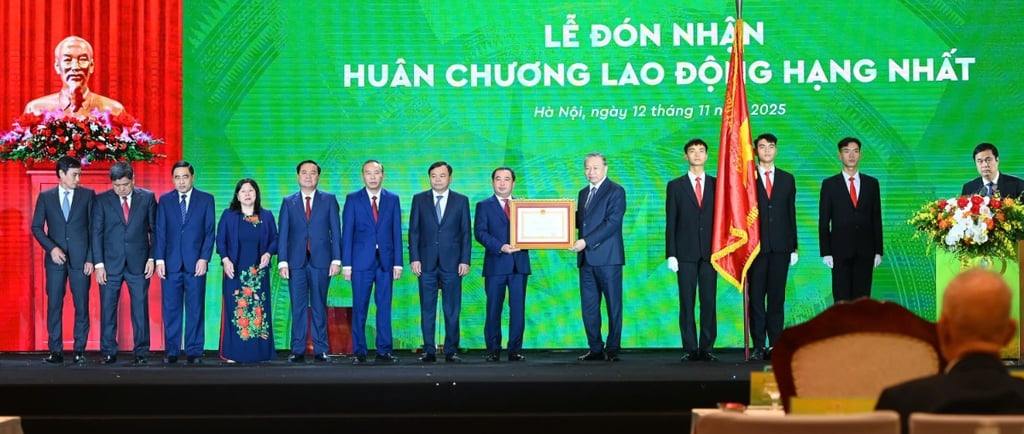
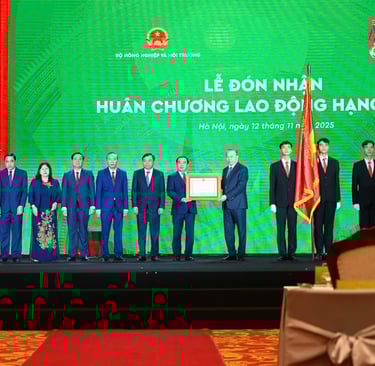
On the morning of November 12, 2025, in Hanoi, the ceremony commemorating the 80th anniversary of the agriculture and environment sector (1945–2025) and the First National Emulation Congress took place solemnly. At the event, the sector was honored to receive the First-Class Labor Medal. On behalf of the Party and State leadership, General Secretary To Lam presented the prestigious award to the Ministry of Agriculture and Environment, recognizing the sector's continuous contributions to the nation's construction and development.
Speaking at the ceremony, Minister of Agriculture and Environment Tran Duc Thang affirmed: “The past 80 years (1945–2025) have been a historical journey full of hardships but extremely glorious; an epic of the strength of will, intelligence, and creative labor spirit of generations, which have contributed to building a green, strong, and developed Vietnam.”
THE HISTORICAL MARK OF AN INDUSTRY WITH AN ENDURING MISSION
Throughout the two wars of resistance (1945–1975), even though the country was engulfed in fierce warfare, the agricultural sector simultaneously produced and fought, successfully fulfilling the mission of "plowing with one hand and fighting with the other." Millions of hectares of land were reclaimed, tens of thousands of irrigation works were built, creating the miracle of "not a single grain of rice lacking, not a single soldier lacking."
After the reunification of the country (1975), agriculture continued to be the mainstay ensuring the people's livelihood. Programs for land reclamation, irrigation, field improvement, and reforestation were vigorously implemented, laying the foundation for later breakthroughs in development.
A crucial turning point came from the reform process. The 1993 Land Law and policies on restructuring crop and livestock production, applying science and technology, and building new rural areas... opened up a period of comprehensive development. From a country facing food shortages and having to import food in the 1980s, Vietnam has become one of the world's leading agricultural exporters. Rice, coffee, cashew nuts, pepper, seafood, fruits and vegetables... consistently rank among the top 5 largest exporters globally, generating tens of billions of USD each year.
In just three decades, the value of Vietnam's agricultural, forestry, and fisheries exports has increased nearly 50 times, placing Vietnam among the top 15 largest agricultural exporters in the world. The National Target Program for building new rural areas has also created strong changes: more than 78% of communes nationwide have met the standards, rural infrastructure has improved, and the multidimensional poverty rate has decreased from 58% in 1993 to 4.06% in 2024.
Mr. Tran Duc Thang, Minister of Agriculture and Environment.
Beyond ensuring food security, the agricultural and environmental sectors are also key forces in protecting natural resources and the living environment. President Ho Chi Minh's ideology on preserving and developing land, water, forests, and seas has always been a guiding principle for all policies and strategies: "If our farmers are prosperous, our country will be prosperous; if our agriculture thrives, our country will thrive."
Minister Tran Duc Thang affirmed: "National strategies on green growth, environmental protection, and climate change response have been strongly implemented. As a result: forest cover rate remains above 42%; many ecosystems have been restored, environmental quality has improved; the rate of household waste collection and treatment has reached 97.28% in urban areas and 83.1% in rural areas. By 2024, Vietnam will rank 54th out of 166 countries in sustainable development, an increase of 34 places compared to 2016 and second in ASEAN."
FIVE GROUPS OF SOLUTIONS FOR A NEW ERA OF DEVELOPMENT
In March 2025, the 15th National Assembly resolved to merge the Ministry of Natural Resources and Environment and the Ministry of Agriculture and Rural Development into the Ministry of Agriculture and Environment. This is a strategic decision aimed at unifying the management of resources, the environment, and agricultural production – forming a multi-sectoral "super ministry".
Minister Tran Duc Thang emphasized that the agriculture and environment sector encompasses many fields, each carrying a sacred mission.
Agriculture: Ensuring national food security.
Forestry: A green shield protecting the environment.
Fisheries and salt production: People who live by the sea, protect fishing grounds, and contribute to affirming national sovereignty.
Rural development and irrigation: Fundamentally transforming the face of the countryside and bringing water to the fields.
Disaster prevention and hydrometeorology: "Measuring wind, counting rain," protecting people's lives and property.
Land, water resources, geology, and minerals: Managing every inch of land, ensuring national resource security.
Surveying, mapping, and remote sensing: Shaping the country's landscape on every map.
Environment, climate change, and integrated marine and island resource management: Preserving living space for generations to come.
Immediately after the merger, the Ministry of Agriculture and Environment streamlined its organizational structure towards greater efficiency and effectiveness; at the same time, it continued to spread the patriotic emulation movement, encouraging officials and employees to overcome difficulties and excellently fulfill their duties.
To achieve the goal of "Developing ecological agriculture, modern rural areas, and civilized farmers," the Ministry of Agriculture and Environment has identified five key task groups.
Firstly, perfecting institutions and modern governance models: comprehensively amending laws on land, water, forests, environment, climate, and agriculture.
Secondly, developing ecological agriculture – green economy – circular economy: applying science and technology, linked to geographical indications and carbon credits.
Thirdly, effectively manage and utilize national resources: ensuring water security, and sustainably exploiting land, forests, minerals, and marine resources.
Fourth, science and technology and digital transformation are the driving forces for breakthroughs: the application of artificial intelligence, big data, and blockchain in resource monitoring and smart agriculture.
Fifth, enhance governance effectiveness and mobilize resources for green transformation: attract climate finance, next-generation ODA, and private capital.
Minister Tran Duc Thang affirmed: "Entering a new era of development, with high determination and great aspirations, the industry will continue to achieve new successes and make important contributions to the cause of building a strong and prosperous nation."
Sources: VN economy
© 2025. All rights reserved.
We are always ready to support your sourcing needs and discuss customized solutions.
Let’s connect and explore how Vietcommodities can become your trusted partner!